
Reviewing "Lost Weekend," by Phoebe Bridgers
The Gen Z laureate gets ghostly serious on her new album

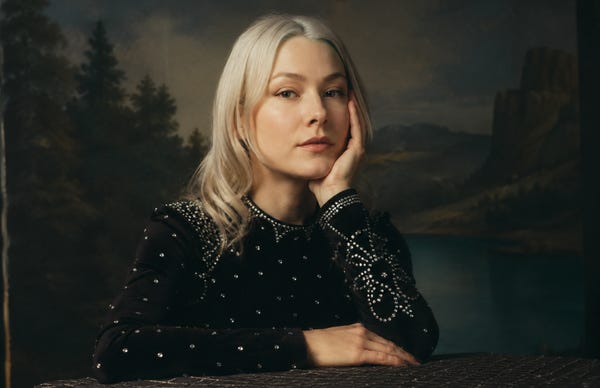
Phoebe Bridgers 101
There are rarely more than a few truly great American songwriters working—let alone peaking—at any given moment. Phoebe Bridgers, now 31 years of age, is one of them: a true emo-folk maestro whose new album, Lost Weekend, is her best yet. When John Mayer first shared her music in 2017, he described “the arrival of a giant.” Conor Oberst called her a “singular songwriter,” and Taylor Swift said that Bridgers’ songs feel like a “precise memory.”
This is all true, and you knew it the first time you heard Phoebe Bridgers, really heard her. For me it was “Motion Sickness,” a folk rock song from her debut album that catalogues the emotional abuse she suffered at the hands of Ryan Adams (more on that below). But the tone is distanced, ironic:
I hate you for what you did
And I miss you like a little kid
I faked it every time, but that’s alright
I can hardly feel anything, I hardly feel anything at all
“Motion Sickness,” released in 2017, made her famous overnight—but Phoebe had been at this for years. Growing up in the (lower) middle-class part of Pasadena, Bridgers spent all her free time making music. She played at the Battle of the Bands in high school, performed Taylor Swift covers at the farmer’s market, and took modeling gigs to pay for recording sessions.
In 2014, over a year out of high school, a friend took her to the PAX-AM studio, the analog hideout owned by indie country star Ryan Adams. Phoebe played a few songs for him, and he freaked out. His energy was manic, irresistible; he demanded she record an EP that very minute, and after spending the rest of the day in the studio they started dating immediately. Adams—then 39 years old—put on the full court press, telling Phoebe that he loved her, that they would go on tour together, and even suggesting they get married as soon as possible.
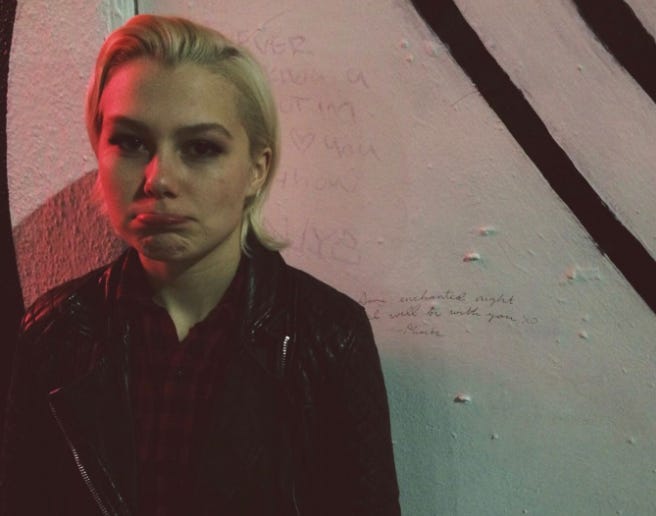
A few months later, Phoebe cut off the relationship, and Adams immediately lost interest in helping her out. The older man slow-rolled the release of her three-track Killer EP, eventually agreeing to put out a limited 7-inch vinyl press. Four years later, the New York Times would report that this was a pattern of predatory behavior towards young women that stretched back years for Adams; after the story broke, he was appropriately exiled from polite society.
Bridgers made the most of her Ryan Adams experience, chaotic and miserable as it was. The Killer vinyl became her calling card; she used it to earn some opener slots on tour with Julien Baker, and it got her in the room with producer Ethan Gruska, who would become her studio muse. She also wrote the aforementioned “Motion Sickness,” which served a dual purpose: it settled her score with a man she greatly disliked, and also defined the core Phoebe Bridgers product—she would deliver exquisitely crafted folk rock, packed with the kind of storyteller pathos that made her hero, Elliott Smith, a legend.
The Bridgers-Gruska sound that debuted on Stranger In The Alps (2017) includes close-mic’d and whispery vocals, re-recorded and layered à la Elliott, backed by a mixture of guitar and pedal steel, flecked with bits of electronic music and noise. Over the years, the electronica has come more to the foreground, and Bridgers has done more to play around with her voice—both expanding the range of her vocal performance and including more digital vocal effects to stretch it into weirder places.
After breaking out, Phoebe started the supergroup Boygenius with Lucy Dacus and tourmate pal Baker; she also recorded a concept album with Conor Oberst of Bright Eyes, under the name Better Oblivion Community Center (the two dated for some time, and he plays harmonica on the new album).
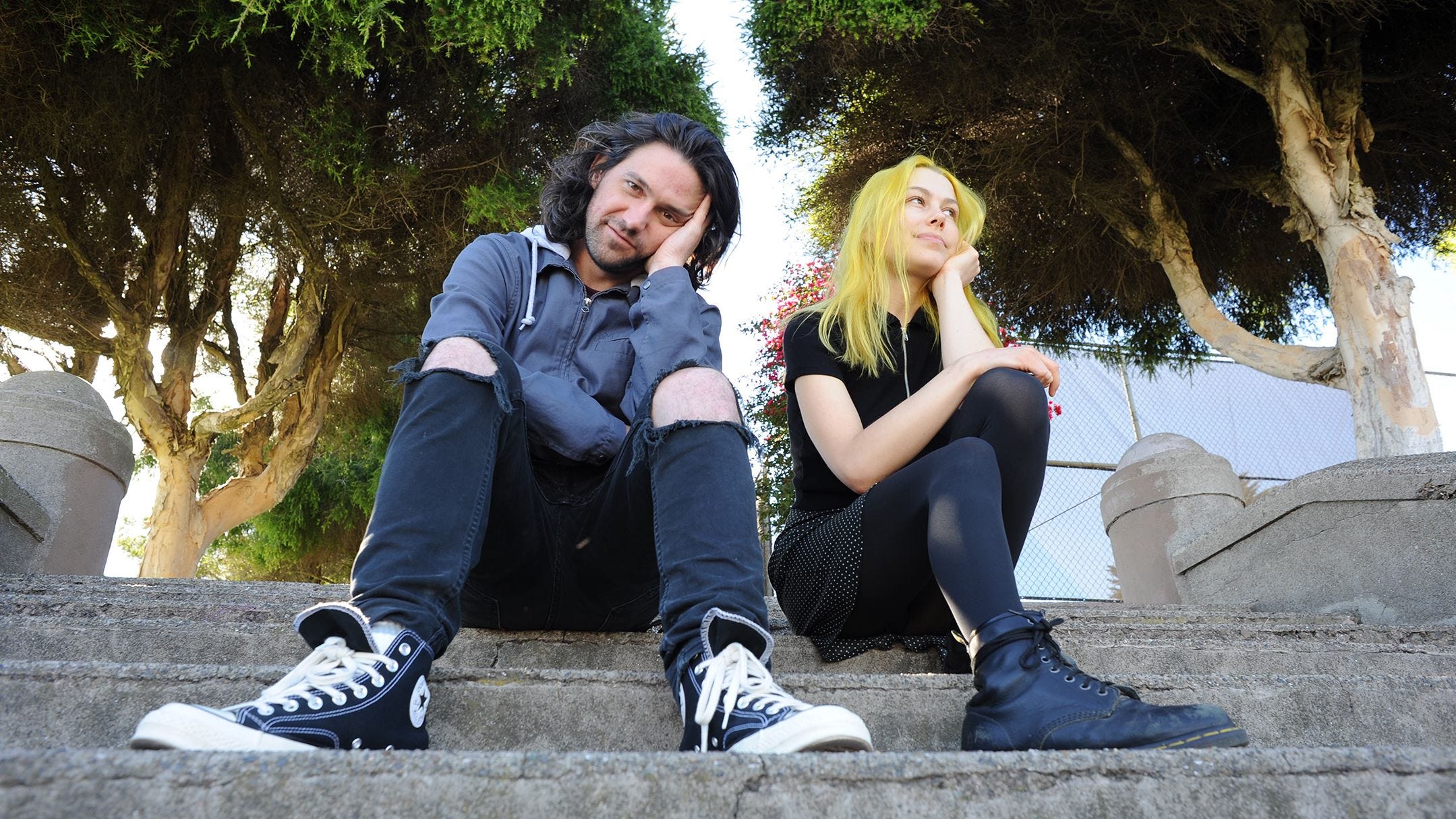
Next came Punisher, in 2020, widely regarded as a classic. The album served to expand her sound, adding more synths, strings, and even a shoegazey noise outro on “I Know The End.” With America stuck at home during the pandemic, Phoebe Bridgers became something closer to a household name—she earned a handful of Grammy nominations and started dating rising A-Lister Paul Mescal.
Six years went by without another solo album. She didn’t disappear, exactly—she opened for Taylor Swift on the Eras tour, won three Grammys with Boygenius, and traded her famous actor boyfriend for a famous comedian boyfriend (Bo Burnham). But fans like me had started to worry that she was destined to become another Frank Ocean: one of our best living songwriters no longer seemed particularly interested in writing songs.
Lost Weekend
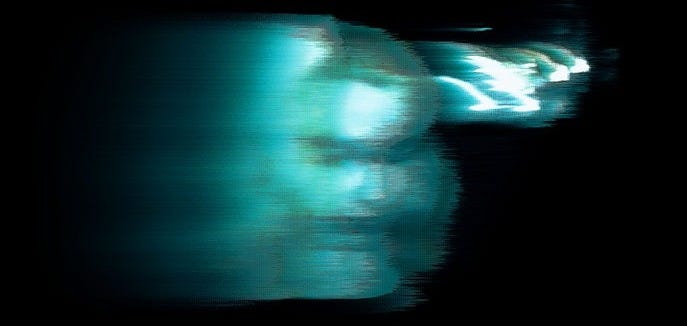
Phoebe Bridgers has finally returned, and Lost Weekend is her most ambitious album yet. It’s a thematic extension of her previous work, mixing dry humor with crushing sadness and layering hyper-specific narrative detail into emo-girl tone poems. It leans harder into experimental folktronica than either of her first two projects; there is a glitchiness to the soundscape, and she plays around with weirder vocal effects.
The album is ghostly, reflected in the cover art; it is haunted by the spectre of her father, who died in 2022 after a decades-long struggle with alcohol abuse. But she also processes her broken-off relationship with Paul Mescal, and wryly asserts the romantic solidity of her current connection with Bo Burnham. It is the best music she has ever made, spanning nearly an hour over sixteen tracks.
P.S. — On at least three songs, the melody of “Graceland Too”—my favorite Phoebe Bridgers song—is sampled and/or interpolated. It’s stunning every time it shows up, and I love the way Bridgers is interacting with, and hallowing, her own best work.
Mourning songs
“The Outside”
“The Outside” is the album’s opening track; through vocoder, Bridgers slips in and out of blurry remembrance as she deliberately channels Imogen Heap.
Crying in a suit and tie
But you should see the other guy
One more time for old time’s sake
I’ll watch him get carried away
Fist through the drywall
I’m frozen in place
But not afraid
Bridgers is often drily funny, and here she’s at a funeral, looking awful, crying—the “other guy” you should see is her father, who is literally dead. Her MFA feel for the literalizing of idiom comes through here as well. “Carried away” means literally being carried away, but it also means losing control, and the listener is slipstreamed into a memory of Bridgers’ abusive father putting his fist through the wall. Lost Weekend lives at the intersection of tragedy and ironic detachment.
I dive into the crowd
And they never let me hit the ground
Way beyond the barricade
Ohio carried me away
Here the vocoder robotically coats the words Ohio carried me away, and the kinetic experience of crowdsurfing is made to sound like a medically-induced coma. She is being carried away from the stage, but also from life, from presence.
“Still Standing”
This is a brilliant, disturbing song, probably the darkest on the whole record. “Still Standing” is not an Elton John pick-me-up. Here the words refer to someone who is stuck in place during a terrible event.
You left your suitcase by the bed
Like you needed to know you could go whenever you wanted
And I’m out on my feet
But I am still standing
When a boxer is “out on his feet,” he is effectively knocked out but somehow standing upright. Here it is less about perseverance and more about dissociation during a traumatic event; the next stanza reveals where she is standing, and reveals that we are in a flashback.
At the top of the stairs, turning red
Pound for pound in a prom dress
You tried to make me afraid
We were both shiningFeeling indifferent, wearing black
Sometimes I want you back
But not today
She is again dissociated—always somewhere else, struck dumb by the chaos around her—“pound for pound,” another boxing metaphor, as her father tries to make her afraid. Then she’s back to the funeral, wearing black, grappling with the complex desire for her father’s death to be undone.
I found her bleeding over the sink
But when you said sorry, you were looking at me
I can’t remember what I said
But I didn’t mean it
Your back to the ocean, burning red
I can’t imagine you dead
But you are every day
Thank you for everything
Bridgers never explicitly positions her mother or her father as a boxer in this song, although they are the ones in the physical altercation. Instead it serves to create an atmosphere of violence, of injury. I’m haunted by these final lines, especially Thank you for everything—it isn’t clear to me where this lands between the twin poles of sincerity and sarcasm.
Processing relationships
“The Governor’s Waltz”
Phoebe Bridgers started dating Paul Mescal in 2020 after flirting with him publicly on Twitter. In November 2022, the Guardian reported that they were engaged to be married—a rumor that was unconfirmed until this very album, where she sings (on “Lost Weekend”) I’m supposed to be married but I called it off. They broke up before the calendar turned to 2023.
This song—a gorgeous bit of music that could pass for an Elliott Smith cover—seems to turn on a chance encounter with Mescal backstage at a music festival.
I was the belle of The Governor's Ball
Hiding in the bathroom like Shelley Duvall
You had a nosebleed, you were in my way
And you didn't remind me of anything
Being famous, the “belle of the ball,” at a music festival should be fun. But Phoebe quickly undermines her own self-image by comparing herself to the scream queen from The Shining, hiding in the bathroom. The encounter leads to a spiral, and she ends up doing an accounting of where their relationship went wrong.
Two kids in a trench coat living alone
I was too happy to feel at home
Dancing ourselves clean late New Year's Eve
You deserved better, you wanted me
The line references the Internet meme of “three kids in a trenchcoat,” pretending to be adults to get into a movie theater. She is using it to communicate an awareness, saying we were just pretending to be adults.
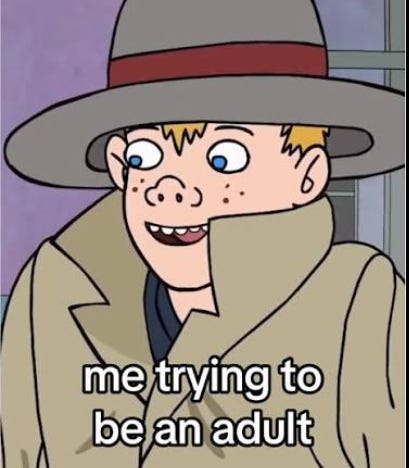
Of course, this is classically immature; what is the difference between pretending to be an adult and being an adult? But the center holds anyways, saved by her admission that Mescal deserved better—he wanted her, and nothing else matters. There is a beautiful production choice here, too; as the stanza ends, we hear a nightclub crowd in the distance chanting an NYE countdown.
Now, let’s see how far I can run without stopping
And she can pretend to be me
Since she took my place, in my bed on that stage
I have not lost any sleep
Being myself wasn’t easy
Do it for me
The closing lines of the song take a direct shot at Gracie Abrams, Mescal’s new girlfriend, who makes mid-tempo music that plays, more or less, like a generic-brand Phoebe Bridgers. “In my bed” means even more than the Mescal connection, because Abrams performed on tour from a bed adorned with rocketship-graphic sheets—the exact same ones that Bridgers had posted on Instagram years ago.
“The Governor’s Waltz” is the prettiest sounding diss track you’ll ever hear; it isn’t as poisonous as Tupac’s “Hit Em Up,” necessarily, but Phoebe isn’t pulling her punches either, and her target is well-defined.


The (sort of) happy songs
“Haunted”
In “Haunted,” Bridgers finds a pocket of optimism and makes a poppy bluegrass song that, were it slightly less hushed, might have been made by Amanda Shires or even KT Tunstall.
So I’m putting on my makeup
While they’re lighting the stage up
Just like candles in a cake
If you’re gonna make a wish, then
You better be specific
You’re gonna have to live it every day
I’m gonna put myself together
You can go or you can stay
I’m gonna put myself together either way
It’s still Phoebe Bridgers, so there’s a world-weary feeling that pervades this song. It is explicitly written from the perspective of I’m really fucking tired, but I still have to do my job. But the focus, ultimately, is on the strength and joy that one finds in doing that job, and doing it well. It reminds me of Taylor Swift’s sarcastic (and impeccable) paean to tour life, “I Can Do It With A Broken Heart.”
“Bobby”
An upbeat indie rock banger about how much Phoebe Bridgers loves Bo Burnham—and because it's Phoebe Bridgers, “Bobby” is shot through with a streak of devastating and self-aware irony.
I saw you slow dancing alone in your room
And I wanted to buy you a new pair of shoes
Now you're walking around with my heart on your sleeve
And I am right here bleeding
So you followed me home like you'd done it before
And you had to bend over to get through the door
And if you didn't like either one of my friends
I'd kill them, I'd kill them
Phoebe saw her man on Netflix (Burnham’s Netflix special, Inside) and decided to reach out. It’s funny that she picked out Mescal in a similar way, developing a crush after watching his performance in Normal People. Being famous is really cool.
Meanwhile, the imagine of a man walking around with her heart on his sleeve—more literalization, and revamping, of idiom. And if he didn’t like either one of her friends (implying she only has two), she would kill them. This is drily anti-feminist, a note that Bridgers clearly delights in hitting.
Bobby, this could be the end of wanting
I exist only if you're watching
The end of wanting is a an ominous way to describe monogamy, reminiscent of David Berman’s mordant the end of all wanting is all I’ve been wanting—which it to say it reminds me of death. As for existing only in the male gaze, I suspect that Bridgers finds the line very funny, and true in a painful sort of way.
The closing songs
“As Above”
The album’s penultimate song might be my favorite, because it strikes me as the most improvisational, something dreamed up and then executed in a flurry of creative energy. It starts with horror-movie piano and her signature talk-singing.
Trying not to look down
Making faces at a kid on the plane
Trying not to freak out about being a couple days late
Started watching a movie, one where they go back in time
And it got to me, I don't know why
Bridgers has discussed the way life as a famous person takes place on a series of airplanes, and “As Above” chronicles a particular bout of travel anxiety, cycling through cascading thoughts about her own parents, and the way she would handle having a child of her own.
I thought about Air Force One flying over Omaha
I thought about my mom driving herself to the hospital
I'm always looking for the exit
I've never been afraid of heights
Now I don't want to live forever
But I don't wanna die
There is a swift, free-associative sequencing to this panic that feels very relatable. We go from random (Air Force One) to traumatic (post-DV hospital visit) to personal flaws, and finally to personal truth: I don’t wanna die. Without warning we flow into the next stanza, as Phoebe speaks to her unborn child (calling back to her late period anxiety) as the reason why she wants to live.
Before I take you to Coney Island
Screaming on the Wonder Wheel
You're gonna take me for granted, but I can handle it
Whatever happens after, it doesn't matter
You won't have to believe in magic
Leave it to me, and I'll make it happen (x2)
You can't imagine
I can't imagine
This is so honest, so vivid. This is the magic of truly great indie songwriting—Phoebe Bridgers doesn’t write for the radio. She doesn’t even write for anyone that doesn’t already love Phoebe Bridgers. Because of this, she can commit to writing whatever the hell is on her mind.
She goes on a tremendous vocal run as the production gets noisier right around You’re gonna take me for granted, hinting at the Florence Welch ranges she is capable of reaching. There is a great deal of Sufjan Stevens (especially Javelin) in this song and this album, as she slowly builds from quiet to loud, from spare to lush.
As above, so below
As above, so below
As it was, so it goes
This song isn’t quite religious, but it plays like a real affirmation by the end. As above, so below; there is a harmony between the ground and the sky. So even when you’re way up there, panicking about your late period and traumatic childhood, take a deep breath—eventually you will touch down, and this too shall pass.
P.S. — She builds an entire song out of mantra elsewhere on this album; I get a real kick out of the simplistic “Never Going Back!”
“Lost Weekend (Reprise)”
He never made it a day in a shirt
He's not comin' back as a bird
He's not coming back
He's not coming back
The stanza begins with a specific memorial description of Bridgers’ father, transitions into a bracing rejection of spiritual belief, and finally into the crushing reality—when people die, they do not come back.
But I still live by the things he taught me
Like how to forgive when they're not sorry
And the government isn't tryna kill you
They just don't care if they kill you
There is something so sweet and therapeutic about this song. Your dad that never apologized for his abuse—even he can transmit a valuable message about the importance of forgiveness. And I especially love this little throwaway detail about the government. Phoebe’s dad wasn’t exactly Q Anon, apparently; he just didn’t trust the government. Like the rest of this song, the line is unvarnished and essentially perfect.
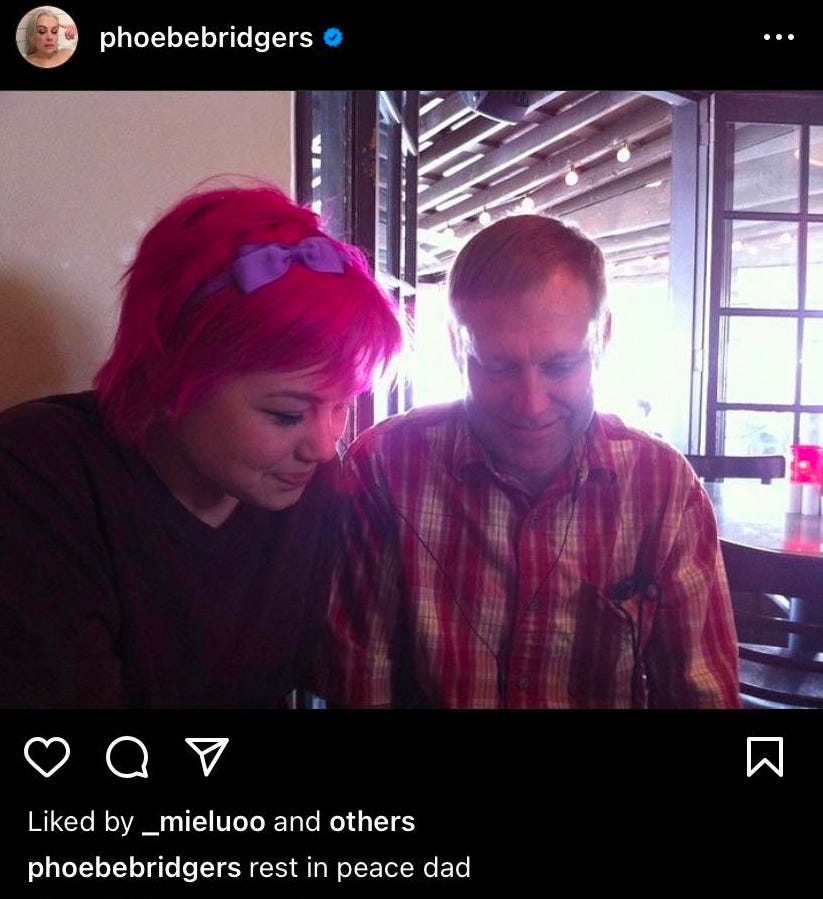
I am my old man’s oldest son
I fought the wall and the wall won
But if I ever come out of hiding
You won’t have to know how to find me again
Phoebe has always tended towards androgyny; she’s openly bisexual, used to wear her hair cropped, and wears a suit and tie more than most male musicians. So these lines are literal, in some sense—she is more like a son than other women might have been. But there is a metaphorical meaning, too. To be an “oldest son” is to bear a weight, to accept a responsibility for the family.
Fighting the “wall,” and the wall winning, is a funny riff on the Clash’s “I Fought The Law.” I’m not sure if it means anything else, and that’s fine. Words have vibes, they have a taste, they impart a synesthetic meaning—to fight the wall, to lose, this is about surrendering.
Now I can’t see any stars in the sky
When a dream comes true, a fantasy dies
But we’re gonna be alright, me and you
You love me and I won’t еver let you forget, not yеt
The album’s closing stanza might be its best. The referenced dream is of her father’s death—in her hit song “Kyoto,” she sang that I’m gonna kill you, if you don’t beat me to it; dreaming through Tokyo skies. Now that he has died, the fantasy of reconciliation has been erased.
But this song is addressed to her partner, and she assures him that we’re gonna be alright, because he loves her—and she won’t allow him to forget it. And then, because this is Phoebe Bridgers we’re talking about, and because she is constantly aware of how fleeting love can be, let alone life itself—she closes with “not yet,” ending an album about ghosts on a note of impermanence.